
Roughly two-thirds of people in India still skip sunscreen as part of their daily routine, often because early attempts left a chalky white cast or a greasy feel that didn’t survive the humidity. That’s changed a lot in the last couple of years — newer formulas are genuinely lightweight, blend invisibly into Indian skin tones, and layer easily under makeup, which is a big part of why interest in specific ingredients like hyaluronic acid and centella has spiked so sharply recently.
We compared three genuinely different formulas across skin types and price points, based on real broad-spectrum protection and how they actually perform in Indian heat and humidity, not just ingredient lists on the label.
Quick Comparison
| Rank | Model | SPF/PA Rating | Best For | Approx Price |
|---|---|---|---|---|
| 1 | Dot & Key Watermelon/Waterlight Sunscreen | SPF 50+ PA++++ | Best overall, no white cast, adds glow | ₹450–600 |
| 2 | Minimalist Sunscreen with Niacinamide | SPF 50 PA+++ | Best value, clean ingredients | ₹350–450 |
| 3 | The Derma Co 1% Hyaluronic Sunscreen Aqua Gel | SPF 50 PA++++ | Best for oily/acne-prone skin | ₹350–450 |
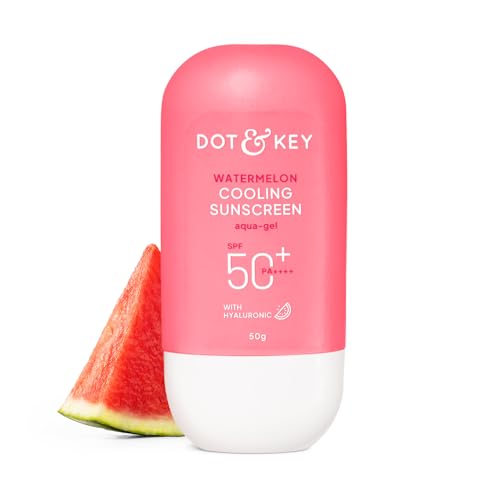

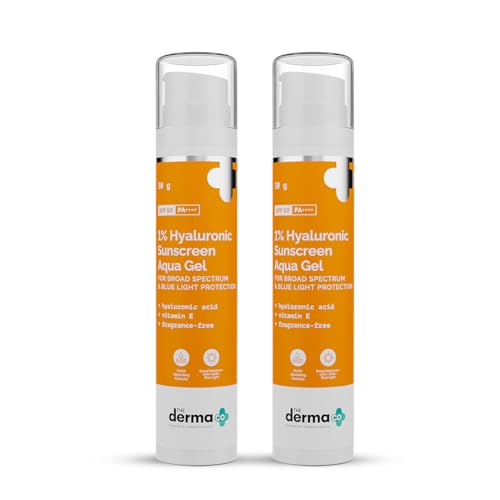
1. Dot & Key Watermelon/Waterlight Sunscreen — Best Overall, No White Cast
Dot & Key has built a genuinely strong following for solving the exact problem Indian sunscreen buyers complain about most — a water-light fluid texture that leaves zero white cast on Indian skin tones, unlike many older-generation physical sunscreens. Vitamin E in the formula also helps soothe skin, and several variants add a visible glow rather than just sitting as a flat protective layer.
Real trade-off worth knowing: at PA++++, this delivers strong UVA protection, but the added glow-boosting ingredients mean it’s formulated more for daily cosmetic wear than pure medical-grade sun protection — genuinely excellent for most people, but not the choice for someone wanting the most minimal, fragrance-free formula possible.
- ✅ Genuinely no white cast — blends invisibly into Indian skin tones
- ✅ PA++++ rating for strong UVA protection
- ✅ Comfortable under makeup, doesn’t feel heavy through the day
- ⚠️ Added glow/tint ingredients may not suit those wanting a completely bare, minimal formula
- ⚠️ Slightly pricier than the most basic budget options
Best for: Daily wear under makeup, and anyone who wants sun protection with a visible glow rather than a flat matte finish.
- INSTANTLY COOLS & HYDRATES SKIN: Daily wear, instantly cooling sunscreen with SPF 50+++ for smooth, luminous & protected…
- INDOOR & OUTDOOR PROTECTION: Powered by UV filters to protect skin against damaging UVA, UVB, blue light, IR & HEV rays.
- PROVIDES BETTER VITAMIN D ABSORPTION: Promotes better absorption of Vitamin D into the skin, making it beneficial to be …
2. Minimalist Sunscreen with Niacinamide — Best Value, Clean Ingredients
True to the brand’s name, this strips out unnecessary additives and fragrance while still delivering a genuinely effective broad-spectrum formula backed by modern UV filters. Niacinamide in the mix does real double duty — helping with pigmentation and skin barrier support alongside sun protection, at a price meaningfully lower than most premium competitors.
Real trade-off worth knowing: at PA+++ rather than PA++++, UVA protection is slightly lower than the premium options above and below — still broad-spectrum and genuinely effective for daily use, but not the top rating available if you specifically want maximum UVA coverage.
- ✅ Lowest price in this comparison without cutting core UV protection
- ✅ Clean, fragrance-free formula with minimal unnecessary additives
- ✅ Niacinamide adds pigmentation and skin barrier benefits
- ⚠️ PA+++ rating, slightly lower UVA protection than PA++++ options
- ⚠️ Fewer added cosmetic benefits (glow, tint) than pricier alternatives
Best for: Budget-conscious buyers who want clean, effective daily protection without paying for extra cosmetic add-ons.
- 1️⃣ Broad Spectrum SPF 50 Protection Formulated with 4 highly effective UV filters — Uvinul T150, Avobenzone, Octocrylen…
- 2️⃣ Boosted with Skin-Repairing Multi-Vitamins Enriched with Vitamins A, B3, B5, E & F to help repair post-sun damage, s…
- 3️⃣ Clinically Tested & Verified SPF 50 Thoroughly tested by an independent lab to confirm SPF 50 protection, ensuring r…
3. The Derma Co 1% Hyaluronic Sunscreen Aqua Gel — Best for Oily/Acne-Prone Skin
This is the pick specifically engineered for skin that struggles with regular sunscreens — a lightweight, non-greasy aqua gel that adds real hydration via hyaluronic acid without clogging pores, which matters a lot for oily or acne-prone skin where heavier formulas often trigger breakouts. It also includes blue light protection, a genuinely useful extra given how much screen time most people get daily.
Real trade-off worth knowing: the hydrating hyaluronic acid formula, while non-comedogenic, is specifically optimized for oily and combination skin — those with genuinely dry skin may find it doesn’t provide quite enough moisture on its own and want a richer moisturizer underneath.
- ✅ Non-comedogenic, lightweight gel — genuinely suited to oily and acne-prone skin
- ✅ Hyaluronic acid adds hydration without heaviness
- ✅ Includes blue light protection alongside UVA/UVB coverage
- ⚠️ May not provide enough standalone moisture for genuinely dry skin types
- ⚠️ Gel texture, less suited to those who prefer a cream-based sunscreen
Best for: Oily, combination, and acne-prone skin that needs sun protection without triggering breakouts.
- PROVIDES BROAD SPECTRUM PROTECTION (PA++++): The PA grading system in sunscreens indicates the level of protection from …
- PROTECTS AGAINST BLUE LIGHT: Blue light, a type of high-energy visible light is emitted by several electronic devices. T…
- NON-GREASY & FRAGRANCE-FREE: Say goodbye to the greasy and oily finish of typical sunscreens. The Derma Co. 1% Hyaluroni…
Buying Guide: What Actually Matters
- SPF 50 is the practical standard for India: SPF 30 is considered the bare minimum; given India’s year-round UV exposure, SPF 50 is what dermatologists generally recommend for daily use.
- PA rating matters as much as SPF: SPF measures UVB protection (sunburn), while PA+++ or PA++++ measures UVA protection (tanning and long-term skin damage). A high SPF with a low PA rating is incomplete protection — check both numbers, not just SPF.
- Broad-spectrum is non-negotiable: If a sunscreen doesn’t explicitly say “broad-spectrum” on the label, it likely isn’t providing complete UVA and UVB coverage regardless of how high the SPF number looks.
- Match texture to skin type: Gel-based formulas suit oily and acne-prone skin. Hydrating, cream-based formulas suit dry skin. Water-resistant formulas matter for outdoor use, sweating, or swimming.
- Application amount matters more than most people realize: Most people apply roughly a third of the amount needed for the labeled SPF to actually work. The standard guidance is about two finger-lengths of product for the face alone.
- Reapplication is not optional: Sunscreen needs reapplying every 2 hours during sun exposure to maintain protection — a single morning application does not last all day, regardless of SPF number.
- SPF in makeup or moisturizer doesn’t count as sufficient protection: These products typically don’t contain enough SPF-active ingredient at the amount people actually apply — a dedicated sunscreen is still necessary underneath.
For dermatological and skin health guidance, see the Indian Association of Dermatologists, Venereologists and Leprologists (IADVL).
Frequently Asked Questions
What SPF should I use daily in India? SPF 50 is generally recommended given India’s year-round UV exposure, though SPF 30 is considered the practical minimum. Look for both a high SPF and a PA+++ or PA++++ rating for complete protection.
Why do some sunscreens leave a white cast and others don’t? White cast typically comes from physical (mineral) UV filters like zinc oxide or titanium dioxide sitting on the skin’s surface. Newer formulas use finer particle sizes or combine chemical and physical filters to blend invisibly, especially important for deeper Indian skin tones.
Is a gel or cream sunscreen better for oily skin? Gel-based, non-comedogenic sunscreens are generally better suited to oily and acne-prone skin, since they’re less likely to clog pores or feel heavy compared to cream-based formulas designed for drier skin.
Does sunscreen in my foundation or moisturizer provide enough protection? Generally no — most people don’t apply enough of these products to reach the labeled SPF level, and a dedicated sunscreen applied as a separate step provides more reliable protection.
Related reading: Best Egg Boiler in India (2026) · Best Electric Toothbrushes in India (2026)
Affiliate Disclosure: This post contains Amazon affiliate links. If you purchase through them, we may earn a small commission at no extra cost to you. All recommendations are based on independent research and genuine buyer feedback.