
Induction cooktops have gone from “backup for when the gas runs out” to a genuine primary cooking option in a lot of Indian kitchens this year — rising LPG prices and supply disruptions in several states have pushed many households to switch, or at least keep a reliable second burner ready. Beyond the emergency-backup angle, induction is simply faster (water boils in nearly half the time versus gas) and safer, with no open flame and automatic shut-off as standard.
The tricky part is the market is genuinely crowded right now, with demand spiking and a lot of lesser-known brands rushing in. We compared three well-established options — a proven bestseller, a genuine budget pick, and a feature-rich option built specifically for Indian cooking habits — rather than chasing whatever’s cheapest from an unfamiliar brand.
Quick Comparison
| Rank | Model | Wattage | Key Highlight | Approx Price |
|---|---|---|---|---|
| 1 | Philips HD4928 | 2100W | Best overall, most-trusted track record | ₹3,500–4,000 |
| 2 | Prestige PIC 20 | 1600W | Best budget pick, proven reliability | ₹2,300–2,500 |
| 3 | Prestige PIC 6.1 V3 | 2200W | Best for Indian cooking (auto whistle counter) | ₹2,900–3,500 |
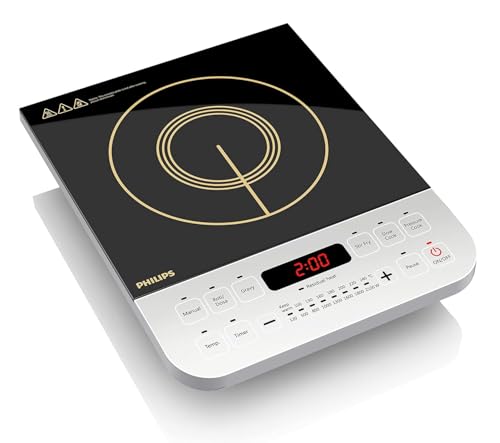

1. Philips HD4928 — Best Overall
With one of the highest review counts of any induction cooktop sold in India, the HD4928 has earned its reputation the straightforward way — reliable daily performance across years of use, backed by Philips’ wide nationwide service network. At 2100W, it’s among the faster-heating options in this comparison, and preset menus cover a solid range of Indian cooking styles from simmering dal to rapid boiling.
Real trade-off worth knowing: it doesn’t have the most modern touch-panel design or the most preset menus in its price range — you’re paying for proven reliability and service reach rather than the flashiest feature list.
- ✅ Extensive, genuinely proven track record with Indian households
- ✅ Fast 2100W heating, handles daily cooking without struggling
- ✅ Nationwide Philips service network — easy repairs if needed
- ⚠️ Fewer preset menus than some competitors at a similar price
- ⚠️ Touch controls can be less responsive with wet or oily hands — common across most touch-panel cooktops, not unique to this model
Best for: Households wanting the most dependable, widely-trusted option without chasing the newest features.
- Joyful Effortless Cooking with Electromagnetic induction technology ensures high heating efficiency, cooks food faster t…
- Programmed for Indian cooking needs
- Enhance the cooking experience with 2100W cooktop that helps in fast cooking
2. Prestige PIC 20 — Best Budget Pick
This is the safest budget buy in the category — tens of thousands of ratings, 4kV surge protection (important given how many Indian homes deal with voltage fluctuations), and Prestige’s reliable service backing at under ₹2,500. Push-button controls are also worth calling out specifically: for Indian cooking where hands are often wet or oily from cooking, physical buttons are more practical than touch panels.
Real trade-off worth knowing: at 1600W, it heats noticeably slower than the 2100–2200W options above and below it — fine for daily cooking, but not the fastest choice if speed is your main priority.
- ✅ Extremely well-proven — huge number of verified ratings
- ✅ 4kV surge protection guards against voltage spikes
- ✅ Push-button controls work reliably even with wet hands
- ⚠️ Lower 1600W output means slower heating than pricier options
- ⚠️ Fewer preset menus than the feature-rich PIC 6.1 V3 below
Best for: Budget-conscious buyers, students, and hostel/PG use where reliability and surge protection matter more than raw speed.
- 𝗛𝗜𝗚𝗛 𝗩𝗢𝗟𝗧𝗔𝗚𝗘 𝗦𝗨𝗥𝗚𝗘 𝗣𝗥𝗢𝗧𝗘𝗖𝗧𝗜𝗢𝗡: Built-in protection guards the appliance’s electronics from sudden line spikes up to 4 kV…
- 𝗣𝗢𝗪𝗘𝗥 𝗦𝗔𝗩𝗘𝗥 & 𝗔𝗨𝗧𝗢𝗠𝗔𝗧𝗜𝗖 𝗩𝗢𝗟𝗧𝗔𝗚𝗘 𝗥𝗘𝗚𝗨𝗟𝗔𝗧𝗢𝗥: Intelligent Power Saver Technology continuously optimizes wattage based on ve…
- 𝟭𝟲𝟬𝟬 𝗪 𝗢𝗙 𝗣𝗢𝗪𝗘𝗥𝗙𝗨𝗟 𝗣𝗘𝗥𝗙𝗢𝗥𝗠𝗔𝗡𝗖𝗘: High wattage delivers rapid heat-up and faster boiling/frying so everyday meals are done…
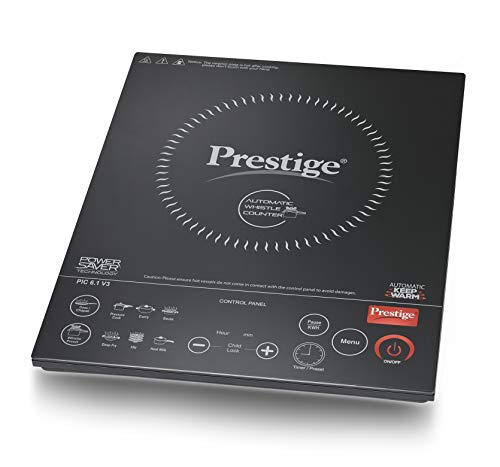
3. Prestige PIC 6.1 V3 — Best for Indian Cooking Features
The standout feature here is genuinely clever: an automatic whistle counter that detects a pressure cooker’s whistles and adjusts cooking time accordingly — useful if you regularly pressure-cook dal, rice, or vegetables and want one less thing to keep track of manually. Combined with 2200W output and 7 Indian menu presets, this is the pick for households that cook a wide range of Indian dishes daily.
Real trade-off worth knowing: it’s priced higher than the basic PIC 20, and the whistle-counter feature specifically only adds value if you actually use a pressure cooker regularly on it — otherwise you’re paying for a feature you won’t use.
- ✅ Automatic whistle counter — genuinely useful for pressure cooking
- ✅ Strong 2200W output with 4kV surge protection
- ✅ 7 preset Indian menus cover a wide cooking range
- ⚠️ Higher price than Prestige’s basic PIC 20 model
- ⚠️ Whistle-counter feature only valuable if you pressure-cook often
Best for: Households that pressure-cook regularly and want an induction cooktop tailored specifically to Indian cooking habits.
- 2000 watts, Automatic Whistle Counter, Automatic Keep Warm Function
- Built in Indian Menu, Dual Heat Sensor
- Automatic Voltage Regulator, Anti Magnetic Wall, Feather Touch Buttons.
Buying Guide: What Actually Matters
- Wattage: 1600W is fine for daily cooking at a relaxed pace. 1800–2200W heats significantly faster — worth it if you cook for a larger family or want gas-stove-like speed.
- Surge protection: Look for at least 4kV surge protection if you live in an area with unstable voltage — a single power spike without protection can permanently damage the induction coil, and an external stabilizer isn’t a substitute since it can’t react fast enough to microsecond spikes.
- Controls: Touch panels look modern but can be unreliable with wet or oily hands — common during Indian cooking. Push-button or knob controls are often more practical day to day.
- Cookware compatibility: Standard induction needs flat-bottomed magnetic cookware (stainless steel or cast iron). If you want to keep using existing aluminium or copper vessels, look specifically at infrared models instead, which work with any cookware type.
- Service network: Brands like Philips, Prestige, and Bajaj have strong nationwide after-sales support — worth prioritizing over a marginally cheaper, less-known brand for a daily-use appliance.
For guidance on electrical safety certification for kitchen appliances, see the Bureau of Indian Standards (BIS).
Frequently Asked Questions
Is induction cooking cheaper than LPG in the long run? Induction cooktops use electricity more efficiently than gas burns fuel, and with LPG prices fluctuating, many households find induction competitive or cheaper for daily cooking, though exact savings depend on your local electricity tariff.
Can I use my existing pots and pans on an induction cooktop? Only flat-bottomed magnetic cookware (stainless steel, cast iron) works on standard induction models. If you want to use aluminium, copper, or non-magnetic cookware without buying new pots, choose an infrared cooktop instead — these work with all cookware types.
How much surge protection do I actually need? 4kV is a reasonable standard for most homes. If you live somewhere with frequent voltage fluctuations, models with 5kV protection offer extra peace of mind.
Is a touch panel or button control better for daily Indian cooking? Push-button and knob controls tend to work more reliably when hands are wet or oily from cooking, which is common in Indian kitchens. Touch panels look sleeker but can be less responsive under those conditions.
Related reading: Best Rice Cooker in India (2026) · Best Mixer Grinder 750W in India (2026)
Affiliate Disclosure: This post contains Amazon affiliate links. If you purchase through them, we may earn a small commission at no extra cost to you. All recommendations are based on independent research and genuine buyer feedback.